River Swimming Safety: Currents, Cold Water and Floods
Status, access and cost come first. Before travelling, check whether your river site is open, seasonal, book ahead, or closed or swimming banned. Confirm that both the route to the bank and swimming itself are lawful, and check any entry fee, permit or booking requirement. A pin on a map is not permission to swim.
Once access is settled, assess the water and the way out. River swimming safety is not just about being a strong swimmer: current can carry you past an exit, cold can impair breathing and grip, and upstream rain can change conditions while the sky above you stays clear.
The before-entry checklist
Complete these checks before changing or entering. If a critical check cannot be completed — particularly permission, flood conditions or a usable exit — choose another activity rather than entering to investigate.
- Check the exact site’s rules. Use the park, council, access authority or landowner’s information. Read signs at the entrance as well: they may be newer than an online page. Do not cross private land, fences or a closed route to reach the river.
- Check today’s warnings and upstream conditions. Look for closures, pollution alerts, flood warnings, rising river levels and reservoir-release notices. Check rainfall across the upstream catchment, not only the forecast at the swimming point.
- Identify your entry, exit and downstream hazards from land. Look for a stable, unobstructed bank or gravel bar you can reach without crossing strong flow. Identify a backup exit. Do not enter if a missed exit would carry you towards a weir, culvert, fallen tree or inaccessible bank.
- Check water quality for this reach. Read the exact site’s official result and sample date, together with any current advisory. A result from a nearby beach or another stretch of river does not describe your swimming point.
- Set a companion and emergency plan. Swim with another competent adult, tell someone on shore your intended route, and record the nearest road, bridge or park entrance. Keep a phone accessible in a waterproof case where there is a signal.
Record the authority and date and time of your status checks. An old “open” notice does not establish today’s conditions. In the UK, relevant checks may involve the Environment Agency, Natural Resources Wales, the Scottish Environment Protection Agency or the site manager. In the US, use the park or land manager, local health authority, National Weather Service and local emergency-management service.
Access rules also differ by location. England’s Countryside and Rights of Way Act 2000 does not create a blanket right to swim in inland waters. Scotland has broader responsible access rights under the Land Reform (Scotland) Act 2003, but restrictions and safety exclusions still matter. In the US, a public river does not automatically provide public access across its banks.
Currents: inspect the route, not just the surface
A smooth surface can conceal strong flow. Water commonly accelerates where a channel narrows, steepens or passes an obstruction. Around bends, faster flow often follows the outside bank; an inviting inside-bend gravel beach can still end in a sudden drop-off.
There is no universal current-speed or river-gauge reading that makes a swim safe. The same reading can mean different conditions at different access points because channel shape, depth, obstructions and exits vary. Use gauges to understand the trend and official warnings, not as a stand-alone permission to enter.
- Stay away from weirs and low-head dams. Water can look smooth above the crest while recirculating flow below holds a person underwater. Do not swim towards the structure or try to climb onto it.
- Avoid strainers. Fallen trees, roots, fencing and other debris let water pass through but can pin a swimmer against them.
- Avoid undercut banks and artificial openings. Banks can conceal submerged cavities or collapse. Culverts and narrow openings concentrate flow.
- Do not rely on shallow water. A foot can wedge between rocks while the current pushes the body downstream. Walking across a fast channel is not a safer substitute for swimming it.
Plan the return before swimming out. A short outward swim can become a difficult return against current, especially after cooling or fatigue. For an unfamiliar river, use daylight and favour a managed swimming area with a straightforward entry and exit rather than an open-water route with uncertain escape points.
If swept downstream: keep your feet up, with feet pointing downstream and toes towards the surface, while steering towards a clear, reachable bank. Do not exhaust yourself swimming directly against the flow; move diagonally towards an accessible exit. Do not stand until the water is shallow and slow enough to do so without foot entrapment. Never try to swim beneath a strainer.
Cold water: breathing can fail before you feel hypothermic
Sudden cold-water immersion can cause involuntary gasping, rapid breathing and loss of swimming control. This cold-shock response happens before hypothermia develops and does not require near-freezing water. A warm afternoon is not evidence of warm river water.
Use a controlled entry rather than jumping in. Enter gradually at the chosen access point and keep the exit close. If gasping or rapid breathing starts, stop trying to swim hard, keep your airway clear and float on your back if needed while breathing settles. Leave the water as soon as you can do so safely.
- Keep a first immersion short and close to the exit. There is no universal safe number of minutes: temperature, clothing, exertion and individual response all matter.
- Leave before coordination deteriorates. Weak grip, clumsy movement or difficulty climbing out are serious problems beside a slippery riverbank. Do not wait for severe shivering.
- Treat a wetsuit as insulation, not protection from current. It does not make a weir, strainer or fast channel suitable for swimming.
- Prepare dry clothing before entering. Put a towel, insulating layer and footwear where you can reach them without a long, uneven walk.
Cooling can continue after leaving the river. Remove wet clothing, dry off and insulate yourself. A warm non-alcoholic drink is appropriate if you are fully conscious and able to swallow. Confusion, drowsiness, slurred speech or a worsening condition require urgent medical help. Alcohol is not a warming strategy.
Rope swings: popularity is not an inspection
An informal rope swing adds several failure points before you even reach the water: the branch, attachment, knot, rope, handle and swing arc. Looking from the bank cannot certify that an unknown swing will hold. Repeated use does not establish landowner approval or structural inspection.
Our recommendation is a controlled entry from an authorised access point instead. It removes rope failure and swing-arc collision from the decision, although the river’s current, cold and underwater hazards still need checking.
- Do not use an improvised swing with unknown inspection and maintenance. Visible fraying, damaged fibres, loose attachments or a moving branch are additional reasons to stay off it.
- Do not use a swing after rainfall or flooding. Flow, depth, submerged debris and the attachment point may all have changed.
- Never dive into unfamiliar river water. Feet-first entry does not make an unknown landing safe either. Permission, current conditions, landing depth and an unobstructed exit all matter.
- At an authorised, managed feature, follow the operator’s restrictions. Keep the landing area clear and never wrap a rope around your hand, arm, neck or body.
A pool that was deep on a previous visit may now contain deposited gravel, a log or exposed rock. Do not jump in to find out. Report a damaged swing or attachment to the landowner or managing authority.

Flash floods: upstream weather matters most
Rain several miles upstream can raise a river after local skies have cleared. Narrow channels and gorges concentrate that flow and can leave few escape routes. Reservoir releases can also change water levels without local rainfall.
Do not enter during or after heavy rain. Check official flood warnings, river-level trends and relevant release notices before leaving home. A rising gauge is a reason to reconsider, not a challenge to fit in a quick swim.
- Leave immediately if water rises or changes colour. Floating branches, a new upstream roar, new foam lines or debris collecting against a bridge are also warning signs.
- Move to high ground. Do not delay to collect clothing, bags or a vehicle. Know the escape route before entering the channel.
- Do not cross floodwater on foot or by car. Hidden holes, fencing, unstable surfaces and powerful flow make apparent depth unreliable.
- Keep away from low crossings, culverts and flood-affected bridges. Debris can block openings and water can undermine approaches.
There is no fixed waiting period after a storm that makes every river suitable for swimming. Levels, pollution and bank damage recover at different rates. If a site was closed, wait for the responsible authority to reopen it, then check current conditions again. Clear-looking water after a flood does not rule out contamination or a changed riverbed.
Water quality: use the exact site’s dated official information
Check both the latest official result and any newer pollution advisory or closure. Record the monitoring authority, exact site, sample date and alert date. A bathing-water classification describes monitored microbiological quality; it does not assess the current, temperature or your ability to get out.
England’s designated bathing-water programme does not cover every river swimming location. In the US, the EPA beach programme primarily covers coastal and Great Lakes recreational waters; river monitoring may instead sit with a state, tribal, county, park or local-health programme.
Where the exact reach has no official monitoring, describe it as “not officially tested”. Where monitoring exists but a current result is unavailable, do not substitute an older result or a nearby site’s result as a same-day clearance. Home dip tests, clear water and a busy bank do not replace official monitoring or closure notices.
- Stay out if you see sewage indicators or suspect algae. Toilet paper, foul odour, visible discharge, unusual scum, dead fish or an official cyanobacteria warning are reasons not to enter. Keep dogs away from suspect algal water.
- Avoid swallowing river water. Bacteria, viruses and parasites can cause illness even when the water looks clean.
- Avoid swimming with fresh wounds. Cover minor cuts with waterproof dressings.
- Seek medical advice after suspected exposure if symptoms persist or are severe. Mention the river swim if you develop vomiting, diarrhoea, fever, abdominal pain, rash, eye irritation or breathing difficulty.
Equipment that helps — and what it cannot do
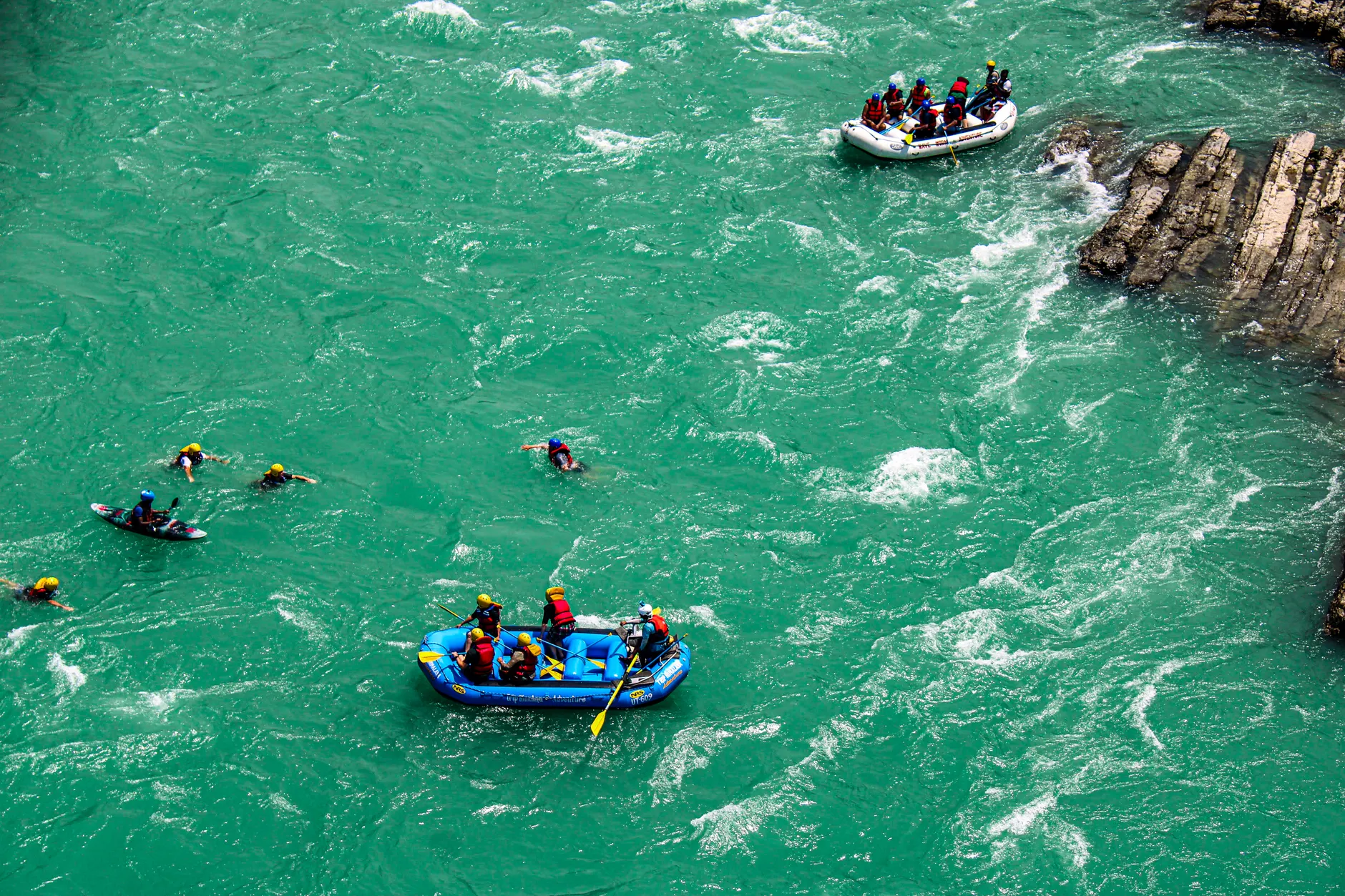
For moving-water activity, use a correctly fitted, approved life jacket or buoyancy aid appropriate to the activity, with the training needed to use it. Neither buoyancy nor protective clothing makes hazardous flow suitable for an untrained swimmer.
- Secure footwear: choose fastening that stays on and soles that protect against sharp debris. Footwear does not prevent foot entrapment.
- Accessible communication: carry a phone in a tested waterproof case and a whistle. Do not bury the phone beneath clothing in a dry bag.
- Visible clothing: high-contrast swimwear helps companions locate you. A tow float is a visibility aid, not a life-saving device; trailing tethers can snag in moving water.
- Dry supplies: pack insulating layers, a towel, food, drinking water and a first-aid kit for a delayed exit.
- No loose beach inflatables: current can carry them beyond the exit or into an obstruction. Never enter the river to recover one.
Avoid alcohol and recreational drugs before swimming. Keep children within arm’s reach, but do not treat adult proximity as protection from strong current: choose water and access arrangements appropriate to the child, preferably a supervised swimming setting.
If someone gets into difficulty
Call 999 in the UK or 911 in the US. Give the river name, precise access point, last known position, direction of travel and visible clothing. Mention downstream hazards such as a weir or fallen tree. Send someone to meet rescuers at the nearest road or gate if enough people are present.
Use the bank-rescue principle “reach or throw, don’t go.” From a secure position, extend a suitable object or throw flotation without entering the current. Rescue ropes require training: a poorly handled line can entangle the swimmer or rescuer. Do not form a human chain or jump in after the casualty.
Once the person is out, monitor breathing and consciousness, shelter them and prevent further cooling. If they are unresponsive and not breathing normally, follow the emergency dispatcher’s CPR instructions and use an automated external defibrillator if available.
The decision at the bank
Enter only where access is lawful, swimming is allowed, current warnings have been checked and a usable exit is clear. Skip improvised rope swings, stay away from weirs and strainers, and leave at the first sign of rising water or declining coordination.
Outdoor swimming is at your own risk. Check official notices, upstream weather, water levels and conditions at the bank immediately before every swim.