Autumn Wild Swimming: Keep Swimming as the Water Cools
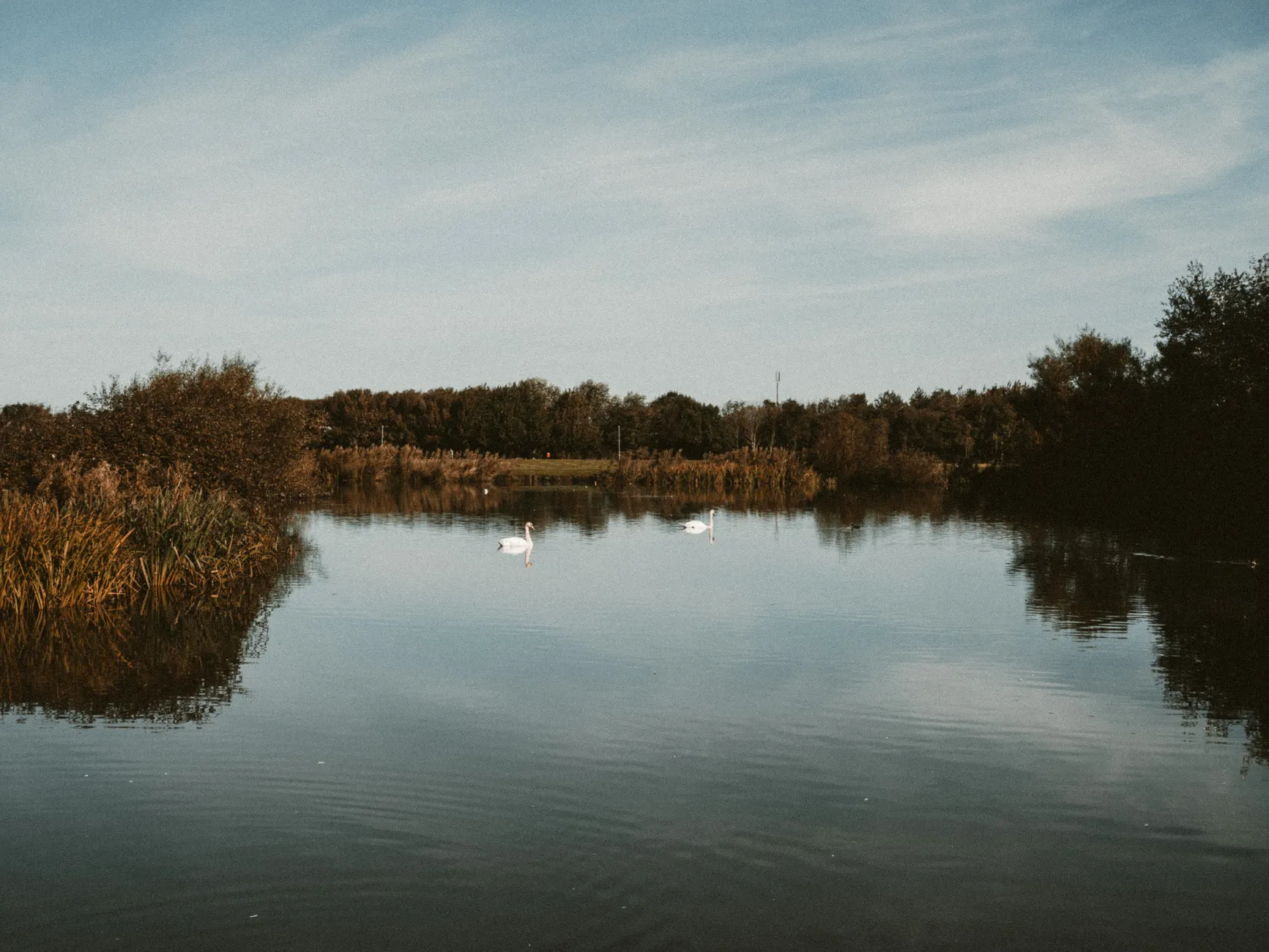
Autumn swimming is an option only where swimming is permitted and the site remains open. Before travelling, check whether your chosen location is open, seasonal, book ahead or closed, along with its autumn entry fee and booking requirements. A public footpath, accessible shoreline or map pin is not permission to swim.
The most useful change as the water cools is to shorten the swim and stay closer to an easy exit — not to preserve your summer distance at a slower pace. Plan the dry clothes, shelter and help you might need before entering.
Guidance reference date: October 2026. This UK and US planning guide does not provide live checks of individual swimming locations, opening hours or water-quality samples.
What changes when autumn water gets colder?
In the UK, inland and coastal water commonly cools substantially between September and November. US conditions vary much more by latitude, altitude and water body. Swimming in October is therefore not a useful temperature category: a sheltered southern lake and a mountain lake can demand very different decisions.
The RNLI describes water below 15°C (59°F) as cold water. Sudden immersion can disrupt breathing, movement and heart rate even in strong swimmers. This is a warning threshold, not a boundary above which swimming becomes safe.
Cold exposure creates several distinct problems. A short swim reduces exposure, but it does not remove the immediate risk of cold shock.
| Hazard | What it means | Practical consequence |
|---|---|---|
| Cold-water shock | Sudden cooling can trigger involuntary gasping, rapid breathing and cardiovascular stress. | Enter gradually. Do not begin swimming while breathing is uncontrolled. |
| Cold incapacitation | Cooling reduces strength, coordination and effective movement. | A swimmer may struggle to climb out or keep swimming before developing hypothermia. |
| Hypothermia | Core body temperature falls below 35°C (95°F). | Confusion, drowsiness or deteriorating coordination require urgent help, not encouragement to finish. |
| Post-exit cooling | Core temperature can continue falling after leaving the water, often called afterdrop. | Getting out is the start of recovery. Dry clothing and shelter need to be ready. |
The US National Weather Service describes cold shock as an immediate response to sudden immersion. Swimming fitness does not prevent it, and feeling comfortable after the initial shock does not show how much longer you can remain in the water.
Check autumn access and official water-quality information
A familiar summer spot can change when lifeguards leave, gates close, booking sessions end or water levels rise. Check the rules for the exact entry point and water body with the land manager or operator. Public access to a park does not automatically permit swimming in its lake, reservoir or river.
- Access: identify the permitted entry point, swimming restrictions and opening hours. For seasonal or book-ahead venues, check the operating dates, available session and fee.
- Staffing: check lifeguard or supervised-session hours separately from general park opening. An open beach may have no autumn lifeguard cover.
- Water quality: read the latest official result and its sample date, plus any current pollution, sewage or harmful-algal-bloom warning.
- Closures: check the responsible authority’s current notices on the day. A previous satisfactory sample does not override a closure.
In England, the Environment Agency’s routine designated bathing-water season generally runs from 15 May to 30 September. An October swimmer may therefore have no current routine sample. The annual classifications — Excellent, Good, Sufficient and Poor — use a four-year assessment period; they are not same-day water-quality results. Scotland, Wales and Northern Ireland have separate official systems and local access rules.
In the US, the Environmental Protection Agency’s BEACON 2.0 system presents monitoring and advisory information from participating coastal and Great Lakes authorities. It does not cover every inland lake, river or spring. Check the relevant state, tribal, county or local health authority as well. Within national parks, the individual National Park Service unit’s regulations and alerts determine where swimming is permitted.
If no official routine testing exists for the location, water quality is unknown. If an official programme exists but has no current sample, an old result cannot fill that gap. Clear-looking water and falling temperatures do not demonstrate low microbiological risk.
Follow rainfall-related pollution warnings. Stormwater, sewage and agricultural runoff can affect water after the surface looks normal again. Stay out where there is an official harmful-algal-bloom warning, surface scum, unusual discolouration, a strong odour or dead fish.
Plan a shorter swim around the exit
Our preferred approach is to choose the exit first, then design the swim around it. A short route beside an accessible shore leaves more room to respond than an outward crossing that commits you to a long return.
- Use the water temperature, not the afternoon forecast. Obtain a site measurement where possible, or measure from a safe position. Sunshine and warm air do not tell you the temperature of a deep lake or shaded river.
- Inspect the entry and exit before changing. Choose access that does not depend on a slippery bank, a difficult climb or swimming against a current. Identify an alternative exit where possible. A ladder that was easy in summer may be difficult with cold hands.
- Assess the water and weather together. Check wind, visibility, daylight and lightning risk. At the coast, add tide, swell, rip currents and offshore wind. On rivers, assess rising levels, current, debris, submerged branches, weirs and sluices.
- Agree a conservative limit with your companion. Keep the route close to the exit and set a turnaround point or time before entering. Symptoms always override the plan. Do not wait for severe discomfort before heading out.
- Leave a recovery margin. Finish with daylight and enough time to change under shelter. Put dry clothing within easy reach rather than leaving it in a distant car.
Do not enter in flood conditions, strong flow, breaking waves, lightning, ice or visibility too poor to judge the route. Leaf litter and low autumn light can hide submerged hazards and make depth harder to assess.
There is no universal safe swimming duration. A “minute per degree” rule cannot account for clothing, body size, health, wind, current or exit difficulty. Survival estimates are not swimming targets. Another swimmer’s ten-minute dip is not a suitable benchmark for your exposure.
Swim with a companion who can monitor you and summon help. Make sure the arrangement does not leave everyone equally cold and unable to assist. Tell someone outside the group your exact location and expected return time, and carry a charged phone in a waterproof case without assuming there will be reception.
Acclimatise without chasing colder or longer swims
Repeated short exposures may make the initial cold response feel less abrupt. They do not create immunity to cold shock, incapacitation, hypothermia or drowning. There is no universal acclimatisation timetable that guarantees a safe duration.
Reduce duration before reducing protective clothing. Keep early autumn swims conservative, particularly after a break, and repeat only once you have fully recovered. There is no requirement to progress towards swimming without a wetsuit.
- Enter gradually. Avoid jumping or diving into cold water. Keep your face clear while you establish controlled breathing, and do not launch into a distance swim while gasping.
- Keep effort comfortable. Hard intervals, underwater challenges and breath-holding add breathing demand and fatigue. Swimming harder is not a substitute for limiting exposure.
- Leave while movement remains normal. Numb hands, clumsy strokes, unusual fatigue, persistent breathlessness or difficulty holding direction are reasons to end the swim.
- Do not extend the plan because the water suddenly feels easier. Reduced sensation and familiarity with the cold do not measure remaining safe time.
For a beginner, an organised, supervised cold-water session with straightforward access is a better starting point than an unfamiliar, unstaffed location. Do not use a first cold swim to test both a new site and a new exposure limit.
Seek medical advice before starting cold-water swimming if you have heart disease, high blood pressure, asthma, diabetes, a seizure disorder or another condition that could affect breathing, consciousness or your response to cold. Skip the swim when ill, exhausted or affected by alcohol.
Choose kit that helps you swim, exit and change
The useful autumn kit is not just what keeps you comfortable in the water. It also needs to preserve visibility, allow an uncomplicated exit and make changing possible when your fingers are less dexterous.
- A well-fitting neoprene wetsuit: it reduces heat loss and adds buoyancy, but does not prevent cold shock or establish a safe swim duration. The fit should not restrict breathing, neck movement or circulation.
- A bright cap: it improves visibility. A neoprene cap adds insulation, but cannot prevent whole-body cooling.
- A suitable tow-float: it improves visibility and may provide support for a rest. It is not a lifejacket and should not be relied on to keep an incapacitated swimmer’s airway clear. Follow its attachment and release instructions; tethers can create snagging hazards.
- Gloves, socks or boots where appropriate: neoprene can help protect cold hands and feet, but may reduce grip and feel. Check that you can still use the intended exit. Water shoes do not guarantee traction on algae-covered rocks or wet metal.
- Goggles suited to the light: clear lenses are useful in overcast autumn conditions when dark lenses make navigation harder.
- A ready-to-use changing kit: towel, dry underwear, loose warm layers, hat, gloves, warm socks, footwear and a windproof outer layer. Keep them dry and in the order you will need them.
Loose layers and simple fastenings are more useful after a cold swim than tight clothing and fiddly buttons. Keep keys and the phone separately protected from wet swimwear. Carry a whistle for attracting attention, and leave headphones out so you can hear companions, boats and changing conditions.
Rewarm before you drive or leave the group
Post-exit cooling means you may feel worse after leaving the water, even when the swim itself felt manageable. Start recovery promptly rather than standing in wet kit to talk or take photographs.
Get out of the wind, remove wet clothing, dry yourself and put on warm, dry layers. Protect the head and torso, and use a windproof outer layer over insulating clothing. A warm, non-alcoholic drink can help with comfort if you are fully alert and swallowing normally; it is not treatment for serious cold illness.
Do not drive while shivering affects control, hands remain numb or concentration is impaired. Stay with your companion until breathing, dexterity and judgement are normal. Feeling warmer at the skin is not enough on its own.
Confusion, marked drowsiness, abnormal breathing, inability to walk normally or stopping shivering despite remaining very cold require emergency help. Handle the person gently, shelter and insulate them, and follow the emergency dispatcher’s instructions. Do not give food or drink to someone who is confused or not fully conscious. Avoid alcohol, very hot baths or direct high heat when hypothermia is suspected.
If cold shock or a swimming emergency occurs
If you fall in unexpectedly or cannot control your breathing, use the RNLI’s Float to Live approach: lean back, keep your airway clear and concentrate on controlling your breathing rather than immediately trying to swim hard. Call for help. Once breathing is controlled, move towards an accessible exit only if you can do so.
- UK coast: call 999 or 112 and ask for the Coastguard.
- UK inland water: call 999 or 112, describe the water emergency and give the precise location.
- United States: call 911 and give the location, access point and nature of the emergency.
Chest pain, faintness, severe breathlessness, confusion or loss of coordination are not symptoms to push through. If someone else is in difficulty, summon help and use suitable rescue equipment from a secure position rather than entering and becoming another casualty.
The autumn swimming plan to keep
Choose permitted access, check the day’s official notices, stay close to an easy exit and make the swim shorter as conditions become colder. Keep your dry kit ready and judge recovery by normal movement and clear thinking — not by whether you completed a target.
Outdoor swimming is at your own risk. Check access, weather, water conditions and official warnings before every swim, and stay out when the conditions or exit are unsuitable.